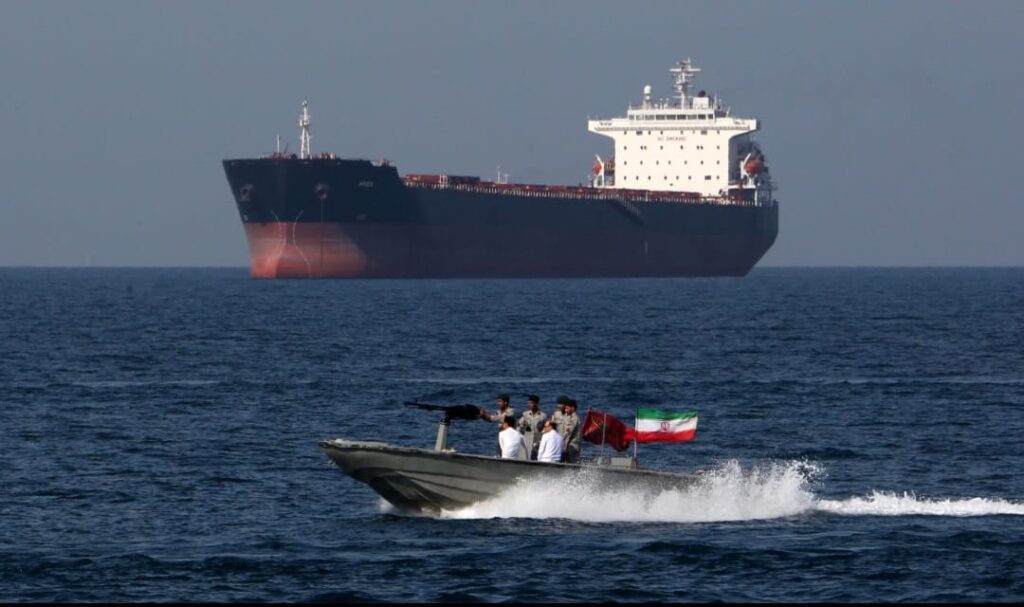
Every time Brent crude jumps another few dollars on fresh U.S.-Iran hostilities, the same debate replays across trading desks: is the world actually short of oil? The honest answer, based on spare capacity sitting across the Gulf and rising Iraqi export volumes, is no — not yet, and probably not for a while. That answer is correct, and it is also almost beside the point. The market has spent months arguing about a supply shock that hasn’t fully materialized while ignoring a distribution shock that already has, and that mispricing is where the real money is being made and lost.
Two different questions, constantly confused
Is there enough oil in the ground” and “can that oil reach a refinery” are not the same question, and financial commentary keeps collapsing them into one. Barrels sitting in Iraqi storage or Saudi spare capacity are not economically identical to barrels delivered to Rotterdam or Yokohama — the difference between the two is transport, insurance, and time, and all three of those have been repriced far more violently than the crude itself. Look at what actually happened to Strait of Hormuz transit volumes during the sharpest phases of this conflict: daily crossings collapsed from well over a hundred vessels to a handful, even though nobody seriously argues the regional supply base itself shrank by that proportion. What collapsed was the willingness of shipowners and insurers to send a vessel through a war-risk corridor at any price the cargo could bear.
That gap — between physical supply and deliverable supply — shows up in a market that headline crude prices don’t fully capture: war-risk marine insurance premiums and spot tanker charter rates. Both have moved by multiples during acute escalation phases, not by the incremental percentages that Brent itself has posted on any given day. A trader watching only the Brent screen is seeing a lagging, blended indicator. A trader watching Hormuz-transiting tanker freight and Lloyd’s-listed war-risk premiums is watching the thing that actually determines whether oil clears the strait tomorrow.
Why this matters more than the headline number
This distinction has a very specific, tradeable consequence: it explains why oil has been more volatile, and prone to sharper round-trip moves, than a pure supply-and-demand model would predict. When insurance and freight costs spike, cargoes don’t stop moving because the oil disappeared — they stop moving because the economics of shipping it collapse at the margin for anyone without a captive fleet or a government backstop, which is precisely why Chinese-linked tonnage has kept transiting the strait through periods when Western-flagged shipping effectively stopped. That’s not a supply story. That’s a market fragmenting into insured and uninsurable lanes, with wildly different effective prices for the same barrel depending on whose flag is on the tanker.
The mispriced trade
Institutional desks pricing this conflict purely through Brent futures are missing the asymmetry sitting one layer down. The crude price reflects an average expectation across all shippers; the freight and insurance markets reflect the marginal cost for the shippers actually willing to run the risk today. When those two diverge sharply — as they have during the sharpest strike-and-retaliation cycles this year — it tends to mean the Brent price is understating near-term physical tightness, because most of the barrels theoretically available are, in practice, temporarily undeliverable at any insurable rate. That divergence closes eventually, usually violently, once either a ceasefire lowers the risk premium or an extended closure forces even the marginal shippers back into the market at a repriced freight rate. Either resolution tends to produce a sharper move in crude than the preceding drift suggested was coming.
What the desk should actually be watching
Brent and WTI are the numbers on every terminal screen, but they are not where this conflict’s next move will show up first. The leading indicators are narrower and less followed: daily UKMTO-tracked transit counts through Hormuz, spot very-large-crude-carrier charter rates on the Gulf-to-Asia route, and war-risk premium quotes from the London marine insurance market. A sustained divergence between rising freight/insurance costs and a comparatively calm Brent tape is the signature of a market underpricing near-term physical risk — and it has preceded several of this year’s sharpest crude spikes by days, not hours.
The uncomfortable conclusion
Treating this as a conventional supply shock — more or less barrels in the ground — misses the mechanism actually setting prices during acute escalation. This is a logistics and insurance shock wearing a commodity-market costume. The desks that have consistently gotten this conflict right this year are the ones pricing the corridor, not just the crude.