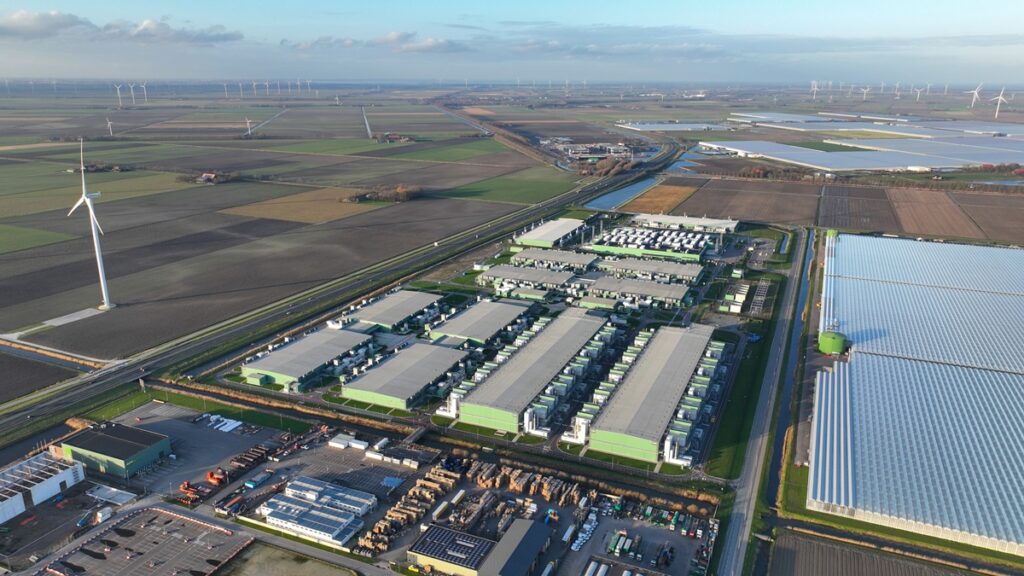
How AI’s hunger for electricity is quietly pricing American families out of their own neighborhoods
Leesburg, Virginia doesn’t look like the front line of a trillion-dollar war. It looks like Loudoun County always has — rolling pasture, the occasional horse fence, subdivisions creeping outward from Route 15. But in November 2025, a company called SDC Capital paid roughly $615 million for 97 acres here. Do the math and that’s about $6.3 million an acre — for land that JK Land Holdings had assembled four years earlier for around $57 million. Ten times the price, four years apart, same dirt.
Nobody bid that up because of the soil. They bid it up because of what runs underneath it: a high-voltage substation capable of feeding a data center.
That’s the story most coverage of the AI boom keeps missing. Everyone’s watching Nvidia’s order book and hyperscaler capex guidance. Fewer people are watching what happens when Meta’s $600 billion three-year infrastructure buildout, Google’s $40 billion Texas expansion, and Amazon’s various regional projects all need the same scarce input — not chips, not even land in the abstract, but powered land. Parcels within reach of transmission capacity that can move hundreds of megawatts. CBRE’s most recent regional report puts site costs in Northern Virginia and the broader Northeast corridor above $8 million an acre now. Hines estimates the world has roughly 20,000 acres of this kind of land occupied by working data centers today, and needs another 40,000 within five years just to keep pace.
Homebuilders can’t compete with that math. Most have quit trying.
Andrew Clark, a lobbyist for the Home Builders Association of Virginia, told state lawmakers in January that data centers are outbidding residential developers across much of the region — not in some markets, across the region. Arif Gasilov, a partner at the sustainability consultancy Gasilov Group, has spent months studying exactly this collision. His verdict was blunt: a residential developer can’t compete. Not “struggles to.” Can’t. Between 2013 and 2021, data centers already ate up close to 30% of all land development in Loudoun and Prince William counties, and the pace hasn’t slowed since — if anything, the last two years have been worse.
It gets more personal than acreage math. In Ashburn — the actual heart of “Data Center Alley” — a developer approached the 143 homeowners of the Regency subdivision with a buyout offer valuing their land at roughly $4.4 million an acre, north of half a billion dollars for the whole neighborhood. It needed unanimous sign-off from every homeowner. It stalled. But the fact that offer got made at all tells you where the ceiling on residential land value now sits in that corridor: wherever a data center developer decides it sits.
Here’s the part that should bother regulators more than it seems to: Virginia’s tax exemption for data center equipment saved operators at least $2.7 billion in state sales and use taxes between 2015 and 2024 — about $1 billion in 2024 alone. Homebuilders get nothing comparable. So the industry that’s outbidding families for land is also the one getting subsidized to do it.
Meanwhile the housing math keeps getting worse on its own. The White House’s own 2026 Economic Report pegs the national housing shortage at 10 million homes. NAHB’s affordability model this year found that 65% of American households can’t afford a median-priced new home at $413,595 with a 6% mortgage — and every additional $1,000 in price prices out another 156,405 households nationwide. In Northern Virginia specifically, the median home price hit $750,000 in 2025, up 54% over a decade. NAHB’s builder confidence index has sat below 40 for fifteen straight months now. Robert Dietz, the group’s chief economist, has been saying the obvious for over a year: land costs, materials, labor, rates — take your pick of headwinds.
None of this is unique to Virginia, either. JLL projects nearly 100 gigawatts of new data center capacity globally between 2026 and 2030, worth roughly $1.2 trillion in real estate value creation — money that has to land somewhere, and increasingly it’s landing on parcels that used to be zoned for people, not servers.
I don’t think this ends with a ban or a moratorium — the capital flows are too large and the political will too thin, especially with AI treated as a strategic asset in Washington. What I’d watch instead is whether states start taxing powered land differently than they tax a subdivision lot, because right now the incentive structure runs entirely one way. Until that changes, don’t be surprised if the next housing shortage headline traces back not to zoning boards or mortgage rates, but to a substation nobody outside the industry had heard of.
