BlackRock TCP Capital Corp (TCPC) closed at $3.08 on June 25, 2026 — its lowest print ever, and less than half of where it was trading nine months earlier. Carlyle Secured Lending is sitting near its own 52-week low. Blue Owl Capital pulled the plug on a merger between two of its credit funds back in November 2025, after investors balked at being locked in while the deal closed. Jeffrey Gundlach has been telling anyone on cable news who’ll listen that private credit reminds him of 2006 — “everything’s overvalued, cracks are starting to form,” as he put it on CNBC in March. Business development companies, the small corner of the market where ordinary investors actually get to see private credit’s numbers, are down high single digits this year even after counting dividends.
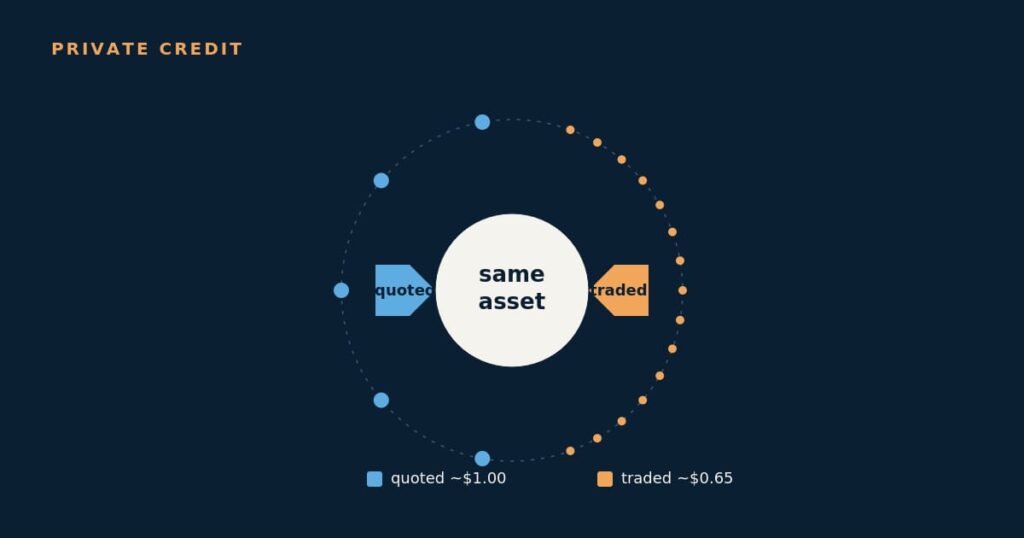
The instinct is to ask whether this is the start of something systemic. It’s a reasonable question. It’s also not the one that tells you much, because it’s aimed at the wrong number. The question worth asking is why two prices for the same pile of loans keep disagreeing with each other, and which one you should actually believe.
Two prices for one asset
Private credit loans don’t trade. There’s no bid-ask, no tape, nothing you’d recognize as a market — just a valuation model, updated quarterly, run by the same firm that made the loan in the first place. Nobody’s forcing that model to be honest in real time; the incentive runs the other way. The BDCs that hold pieces of these loan books are the opposite. Their shares trade all day, priced by people who have no reason to protect anyone’s marks.
So when TCPC or Carlyle Secured Lending trades meaningfully below the net asset value its own manager is reporting, that’s not noise. It’s the market telling you it doesn’t believe the mark yet.
TCPC is the clean example, mostly because the company was forced to make it one. On January 23, 2026, after the close, it filed an 8-K disclosing that fourth-quarter NAV would come in about 19% lower than the prior quarter — driven largely by writedowns on six positions, with Edmentum, a loan called Razor written all the way to zero, and SellerX accounting for most of the damage. NAV went from $8.71 to $7.07 a share. The stock, which had already been sliding for months, dropped as much as 16.7% intraday on the news. KBRA cut its rating a few days later. A class action followed in early February. By September, CEO Phil Tseng was gone.
None of that NAV cut was new information to anyone watching the stock. TCPC’s share price had been signaling trouble since well before January — the filing just made it official.
Where private equity inherits the problem
This matters beyond BDCs because so much leveraged buyout financing has shifted onto private credit balance sheets over the past few years. A private equity fund’s NAV depends on its portfolio companies’ health, which depends on the credit that financed them, which is itself marked by the same slow, self-reported process described above. You end up with one lagging estimate resting on top of another, and nothing forcing either one to reset in real time.
What’s actually worth watching
Not the sector default rate. Not this quarter’s dividend cuts — both are backward-looking by the time you see them. Watch the gap between BDC share prices and their own reported NAVs, across the sector, over several quarters. If that gap stays wide even as reported NAVs hold steady, the market is pricing in writedowns the funds haven’t taken yet. The gap closes one of two ways: NAVs fall to meet the stock price, or the stock price recovers because the market decides it overreacted. Watch which one actually happens — it tells you whether the discount was fear or foresight.
TCPC’s own history over the past year argues for the first outcome. Whether the rest of the sector follows the same script is the thing to actually watch, not the headline default numbers everyone else is staring at.